
Rejection sensitive dysphoria (RSD) is an intense, overwhelming emotional pain response triggered by real or perceived rejection, criticism, or failure — and it’s especially common in people with ADHD. It’s not a formal DSM or ICD diagnosis, but clinicians widely recognize it as a significant pattern of emotional dysregulation that can disrupt relationships, work, and daily life. If you think you might be experiencing RSD, here are three things you can do right now:
-
Ground yourself in the moment. When an episode hits, try the 5-4-3-2-1 technique: name five things you can see, four you can touch, three you can hear, two you can smell, and one you can taste. This interrupts the emotional spiral before it peaks.
-
Validate without reinforcing distortions. Say to yourself: “This feeling is real and intense, but it may not reflect the full picture.” You’re not dismissing the pain — you’re creating a small pause between the feeling and your reaction.
-
Seek a clinical evaluation. RSD-like symptoms overlap with several other conditions. A licensed therapist or psychiatrist can help you understand what’s driving your emotional reactivity and build a plan that actually fits your situation.
Table of Contents
-
Daily management, workplace strategies, and where to find support
-
The Rowney-Smith triad: a new way to understand RSD meltdowns
-
Sunshinecitycounseling can help you understand and manage RSD
What is rejection sensitive dysphoria?
Rejection sensitive dysphoria is an extreme emotional pain response — often described as a sudden, crushing wave of shame, grief, or rage — that’s triggered by the perception of being rejected, criticized, or falling short of a personal standard. The key word is perception: the triggering event doesn’t have to be real or intended. A neutral tone in a text message, a colleague who doesn’t smile back, a performance review with one critical comment — any of these can set off an episode that feels completely disproportionate to the situation.
Clinicians recognize RSD as a manifestation of extreme emotional dysregulation rather than a standalone diagnosis. It doesn’t appear in the DSM-5 or ICD-11 as its own condition, which means there’s no single diagnostic code a clinician checks off. Instead, RSD is understood as a pattern that shows up within other conditions, most commonly ADHD, and is assessed as part of a broader clinical picture. That distinction matters when you’re seeking help, because treatment targets the underlying regulatory difficulties rather than RSD as an isolated label.
The term itself has grown out of both clinical practice and the neurodivergent community’s effort to name an experience that many people felt was invisible or dismissed. Research on RSD is still developing — existing studies are largely qualitative, with variable prevalence data and a recognized need for more reliable measurement tools. That doesn’t make the experience less real. It means the science is catching up to what many people have been living with for years.
How is RSD different from ordinary rejection sensitivity?
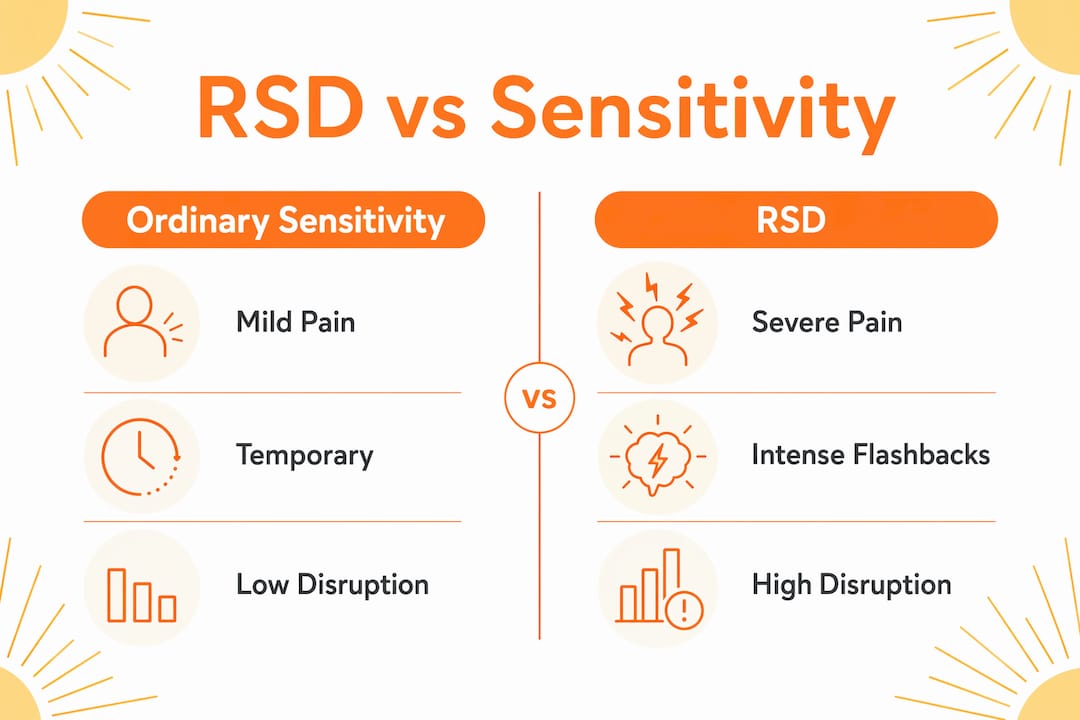
Everyone feels stung by rejection sometimes. The difference with RSD isn’t just that the pain is stronger — it’s that the intensity, duration, and functional fallout are in a different category altogether.

| Feature | Typical rejection sensitivity | Rejection sensitive dysphoria |
|---|---|---|
| Trigger | Clear, real rejection or criticism | Real or perceived; often ambiguous cues |
| Intensity | Uncomfortable but manageable | Overwhelming; described as unbearable |
| Duration | Hours at most; fades with distraction | Can last hours to days; hard to interrupt |
| Physical symptoms | Mild sadness, some tension | Chest tightness, nausea, physical paralysis |
| Functional impact | Temporary mood dip | Withdrawal from relationships, work avoidance |
| Recovery | Resolves naturally | Often requires active coping or support |
A quick self-check: if you regularly experience more than three of the following, a clinical conversation is worth having.
-
You feel sudden, intense shame or rage in response to a perceived slight, even when you know logically it may not be intentional.
-
You spend hours or days replaying a comment, convinced it signals rejection.
-
You avoid situations (social events, feedback conversations, creative work) to prevent the possibility of criticism.
-
Your emotional reaction feels completely out of proportion, and you can’t easily talk yourself down.
-
Episodes have cost you relationships, job opportunities, or your sense of self-worth.
The functional impact is the clearest signal. Ordinary sensitivity hurts; RSD disrupts.
What does an RSD episode actually look like?
The core symptom cluster in RSD combines sudden emotional flooding, physical sensations, and behavioral responses that can look very different from the outside than they feel on the inside.
Emotional symptoms:
-
Sudden, overwhelming shame or humiliation
-
Intense grief or a sense of being fundamentally unlovable
-
Explosive anger or rage (sometimes directed inward)
-
Anxiety that feels physical, not just mental
Behavioral symptoms:
-
Withdrawal from the person or situation involved
-
Masking responses — performing calm or happiness to hide the internal storm
-
Avoidance of future situations that might trigger a similar response
-
Lashing out, then feeling deep remorse
Physical sensations:
-
Heart or throat tightening
-
Heat flushing through the body
-
Nausea or stomach upset
-
A sense of physical paralysis or inability to move
What a typical episode looks like in practice: imagine you send a message to a close friend and they don’t respond for a few hours. For most people, that’s mildly annoying. For someone with RSD, the silence can trigger a cascade — first a creeping dread, then a certainty that the friendship is over, then a wave of shame so intense it’s hard to breathe. The person might withdraw, cancel plans, or send an apologetic message trying to “fix” something that was never broken. When the friend finally responds with a simple “sorry, busy day,” the relief is real but the emotional hangover can last.
Warning signs that require immediate help:
-
Thoughts of self-harm or suicide during or after an episode
-
Inability to function (can’t get out of bed, can’t work, can’t care for yourself or dependents)
-
Episodes that are escalating in frequency or severity
If you’re experiencing suicidal thoughts, contact the 988 Suicide and Crisis Lifeline by calling or texting 988.
Pro Tip: Keep a brief episode log — date, trigger, intensity (1–10), and what helped. After a few weeks, patterns emerge that are genuinely useful in therapy and often surprising to the person keeping the log.

What causes RSD, and who is most at risk?
RSD likely develops through a combination of neurobiological differences in emotional regulation, genetic predisposition, and environmental factors like early interpersonal trauma or chronic invalidation. No single cause explains it, and for most people it’s a mix of all three.
Common risk factors and comorbid conditions:
-
ADHD: The strongest and most studied association. Emotional dysregulation affects 25–45% of young people with ADHD and 30–70% of adults with ADHD, depending on the sample and measurement approach.
-
Autism spectrum conditions: Heightened sensory and social sensitivity can amplify rejection responses.
-
Anxiety disorders: Generalized anxiety and social anxiety both increase baseline threat sensitivity.
-
Depression: Negative cognitive patterns overlap significantly with RSD’s shame-based thinking.
-
Trauma-related conditions: Childhood emotional neglect, chronic invalidation, or complex PTSD can wire the nervous system toward hypervigilance around social threat.
-
Mood disorders: Bipolar disorder and cyclothymia can produce emotional reactivity that resembles RSD and requires careful differential diagnosis.
| Population | Emotional dysregulation estimate | Notes |
|---|---|---|
| ADHD youth | 25–45% | Varies by sample and measurement tool |
| ADHD adults | 30–70% | Higher range reflects broader self-report measures |
| General population | Lower baseline | No comparable published range for RSD specifically |
Clinicians also rule out medical contributors before settling on a psychological explanation. Thyroid dysfunction (both hypo- and hyperthyroidism) can produce mood instability and emotional reactivity that mimics RSD. Sleep disorders, including sleep apnea and chronic insomnia, significantly impair emotional regulation. Certain medications — stimulants, corticosteroids, some antidepressants — can heighten emotional reactivity as a side effect. If your symptoms appeared or worsened suddenly, a medical workup is a reasonable first step.
Accurate assessment matters because treatment differs significantly depending on what’s actually driving the emotional dysregulation. RSD within ADHD responds differently than RSD rooted primarily in complex trauma, and conflating the two leads to treatment that misses the mark.
How do clinicians assess RSD?
Clinicians approach RSD as a pattern within emotional dysregulation rather than a standalone diagnosis, which shapes how an evaluation unfolds. You won’t be handed a single test with a clear result. Instead, a thorough evaluation maps your experience onto validated clinical constructs — emotional dysregulation, PTSD, mood disorders, autism presentations — to identify what’s actually driving the reactivity and what treatment approach fits.
Here’s what a typical evaluation process looks like:
-
Developmental and personal history. The clinician will ask about your childhood experiences with criticism and rejection, attachment relationships, and whether emotional reactivity has been present since early life or emerged later.
-
Trigger mapping. You’ll describe specific examples: what happened, how you interpreted it, what you felt physically and emotionally, and how long it lasted. This helps distinguish RSD from mood episodes, which tend to be less tightly tied to specific triggers.
-
Functional impact assessment. The clinician asks how emotional reactivity affects your relationships, work, and daily functioning — not just whether it’s painful, but whether it’s impairing.
-
Screening for comorbid conditions. Standardized tools for ADHD (such as the Adult ADHD Self-Report Scale), anxiety, depression, and trauma are typically part of the picture.
-
Medical rule-outs. If not already done, the clinician may recommend thyroid function tests, a sleep evaluation, or a medication review to rule out physiological contributors.
-
Differential diagnosis. The clinician considers whether the emotional pattern fits better with a mood disorder, PTSD, autism, or ADHD — or some combination — because RSD-like symptoms overlap with several conditions that require different treatment approaches.
What to bring to your first appointment: a written list of three to five specific episodes (trigger, your interpretation, emotional and physical response, duration, and what helped), any prior diagnoses or medications, and a note on whether symptoms are worse at particular times of day, month, or year.
Seek urgent care if you’re experiencing thoughts of self-harm or suicide, or if episodes are preventing you from meeting basic needs. In those situations, an emergency room or crisis line is the right first call, not a scheduled intake appointment.
Evidence-based treatment and practical coping strategies
There is no single cure for RSD, but a combination of evidence-based therapy and practical skills training can meaningfully reduce both the frequency and intensity of episodes. The goal isn’t to stop feeling — it’s to build enough of a gap between trigger and reaction that you have a choice about what happens next.
Therapy options
CBT and DBT-informed approaches are the most commonly recommended starting points. Cognitive Behavioral Therapy helps you identify and challenge the distorted thoughts that feed the dysphoria — the leap from “they didn’t text back” to “they hate me” to “I’m fundamentally unlovable.” That chain moves fast, but it can be interrupted with practice. DBT skills, particularly emotion regulation and distress tolerance modules, give you concrete tools for riding out an episode without making it worse.
Trauma-informed care is especially relevant when RSD is rooted in early experiences of chronic invalidation or emotional neglect. Approaches like EMDR or somatic-based therapies address the nervous system’s learned threat response at a deeper level than cognitive reframing alone can reach. For many people with ADHD and RSD, a combination of CBT-based skills and trauma-informed stabilization produces the best real-world reductions in avoidance and masking.
The role of medication
ADHD medications — stimulants and non-stimulants alike — can reduce RSD-like reactivity for some people, likely because they improve the broader emotional regulation difficulties that underlie ADHD. No medication is specifically approved for RSD, and prescribing for this purpose is off-label. Some people find that alpha-2 agonists (like guanfacine) or certain antidepressants help with emotional reactivity; others find stimulants alone are sufficient. Medication decisions should always involve a prescriber who knows your full history, because interactions and individual responses vary considerably.
In-the-moment coping
The 5-4-3-2-1 grounding technique mentioned in the opening is a good starting point, but body-based tools work best when they’re practiced before an episode, not just during one. Other approaches that help:
-
Feeling labeling: Say out loud or write down the specific emotion (“I feel ashamed” rather than “I feel terrible”). Research on affect labeling suggests naming an emotion reduces its intensity by engaging the prefrontal cortex.
-
Self-soothing scripts: A short phrase you’ve prepared in advance — “This is an RSD moment. It will pass. I don’t need to act on it right now” — can interrupt the automatic behavioral response.
-
Physical regulation: Cold water on the face, slow diaphragmatic breathing, or a brief walk can shift the physiological state enough to create space for a more deliberate response.
Talking to partners and supporters
The most helpful thing a partner or friend can do during an episode is validate the feeling without confirming the distorted interpretation. That sounds like: “I can see you’re in a lot of pain right now, and that makes sense. I’m not going anywhere.” What doesn’t help: arguing about whether the trigger was “real,” offering reassurance that inadvertently reinforces the fear (“Of course I don’t hate you, I could never hate you!”), or withdrawing out of frustration. Supporting a loved one through intense emotional episodes is genuinely hard, and caregivers benefit from their own support too.
Daily management, workplace strategies, and where to find support
With the right structures in place, most people with RSD can reduce how often episodes derail their day. The goal is to lower the baseline threat level so triggers land with less force.
Workplace adjustments that help:
-
Request written feedback rather than verbal-only reviews, which gives you time to process before reacting.
-
Ask for structured, regular check-ins with your manager rather than sporadic feedback, so you’re not reading ambiguity into long silences.
-
If you have an ADHD diagnosis, reasonable accommodations under the ADA may include written communication preferences or modified feedback formats — a conversation with HR or an employment attorney can clarify what applies to your situation.
-
Identify a trusted colleague you can reality-check with when you’re unsure whether a situation is as threatening as it feels.
Relationship strategies:
-
Share what RSD is with close partners or family members before an episode, not during one. A calm, informed conversation about your experience is far more productive than an explanation offered mid-meltdown.
-
Agree on a “pause signal” — a word or gesture that means “I’m in an episode and need space, not a conversation right now.”
-
After an episode passes, use repair language: “I know I withdrew earlier. I was in a really intense emotional place. Can we talk about it now?”
Where to look for support:
-
Therapists who specialize in ADHD, emotional dysregulation, or trauma-informed care are the most relevant clinical fit. Look for licensed clinical social workers (LCSWs), licensed professional counselors (LPCs), or psychologists with documented ADHD or trauma specialties.
-
CHADD (Children and Adults with Attention-Deficit/Hyperactivity Disorder) offers peer support groups and a professional directory at chadd.org.
-
The ADHD and You community and ADDitude Magazine’s online forums provide peer connection for people navigating RSD alongside ADHD.
What’s the outlook, and can episodes become less frequent?
Many people with RSD see meaningful improvement with targeted therapy and consistent support. The realistic goal isn’t the elimination of all emotional reactivity — it’s a reduction in intensity, a faster recovery time, and a growing ability to recognize an episode for what it is while it’s happening rather than only in hindsight.
Timelines vary. Some people notice a shift in reactivity within a few months of starting therapy; for others, especially when complex trauma is involved, progress is slower and more nonlinear. What tends to predict better outcomes is consistency: regular therapy, medication adherence when prescribed, and deliberate practice of coping skills between sessions.
Prevention habits that lower trigger frequency over time:
-
Prioritize sleep. Emotional regulation is significantly more fragile on poor sleep, and for people with ADHD, sleep disruption is already common.
-
Build structured feedback loops into your relationships and work life so ambiguity — one of RSD’s biggest triggers — is reduced.
-
Practice coping rehearsal: mentally walk through a likely trigger scenario and your planned response before it happens. This primes the nervous system to recognize the pattern.
-
Maintain medication adherence if ADHD medication is part of your plan, since missed doses can sharply increase emotional reactivity.
-
Notice early warning signs (a particular physical tension, a familiar thought pattern) and use them as a cue to deploy coping tools before the episode peaks.
Rebuilding confidence after RSD has affected your work or relationships is its own process, and it’s one that therapy can support directly.
The Rowney-Smith triad: a new way to understand RSD meltdowns
A 2026 qualitative study by Rowney-Smith and colleagues identified a consistent triad of experiences across people describing RSD episodes: intense bodily sensations, masking, and withdrawal. This triad is clinically useful because it describes the internal architecture of a meltdown in a way that’s recognizable both to the person experiencing it and to the people around them.
-
Bodily sensations vary widely across individuals — heart or throat tightening, heat, nausea, a sense of physical paralysis — but are almost always present and often arrive before the emotional content is fully conscious. This is why body-based grounding techniques tend to work better as early interventions than purely cognitive ones.
-
Masking is the effortful performance of calm or normalcy while the internal experience is intense. It reduces visible symptoms in the short term but increases internal load over time, and it can make it very hard for caregivers to recognize that an episode is happening at all.
-
Withdrawal follows masking when the internal load becomes unsustainable. The person pulls back from the interaction, sometimes abruptly, which can itself be misread as rejection by the other person — creating a painful feedback loop.
“Participants described a consistent pattern: first the body signals threat, then the mask goes up, then the withdrawal. Understanding that sequence changes how caregivers can respond — the window for helpful intervention is early, before withdrawal locks in.” — Rowney-Smith et al. (2026), PMC qualitative study on RSD in ADHD
Caregiver do’s and don’ts based on the triad:
| Do | Don’t |
|---|---|
| Offer calm, non-demanding presence early in the episode | Push for conversation or explanation during peak intensity |
| Validate the feeling without confirming the distorted belief | Argue about whether the trigger was “real” |
| Give space when withdrawal begins, with a clear “I’m here when you’re ready” | Interpret withdrawal as rejection and pull away yourself |
| Return to the topic gently after the nervous system has settled | Assume the episode is over just because the person looks calm |
A clinical evaluation can help you and your support network understand where in the triad you typically get stuck and which interventions fit your specific pattern.
Key Takeaways
Rejection sensitive dysphoria is a clinically recognized pattern of extreme emotional dysregulation, most common in ADHD, that responds well to targeted therapy, practical skills training, and informed support from people close to you.
| Point | Details |
|---|---|
| RSD is not a formal diagnosis | It’s a recognized pattern of emotional dysregulation, not a standalone DSM/ICD condition. |
| ADHD is the strongest link | Emotional dysregulation affects a sizable portion of people with ADHD, with research estimates ranging from 25–45% in youth and 30–70% in adults with ADHD, depending on the sample and measurement approach. |
| Therapy is the primary treatment | CBT, DBT-informed skills, and trauma-informed care reduce episode frequency and avoidance. |
| The Rowney-Smith triad guides response | Bodily sensations, masking, and withdrawal signal an episode; early intervention works best. |
| Sunshinecitycounseling offers targeted support | The clinic provides ADHD-focused, trauma-informed therapy in St. Petersburg, FL, and online. |
What working with RSD has taught me
The most underappreciated thing about RSD is how invisible it is from the outside. A person in the middle of an episode often looks fine — maybe a little quiet, maybe slightly withdrawn. The internal experience, though, can feel catastrophic. That gap between appearance and reality is exactly what makes RSD so isolating and so frequently misunderstood, even by people who genuinely care.
What I’ve seen consistently in clinical work with ADHD and emotional dysregulation is that the shame people carry about their reactivity is often heavier than the reactivity itself. They’ve been told they’re “too sensitive,” “dramatic,” or “overreacting” for so long that they’ve internalized the criticism. The first real shift in therapy often isn’t a reduction in episode intensity — it’s the moment someone realizes that their nervous system is responding to a real pattern, not a character flaw.
The Rowney-Smith triad is valuable precisely because it gives that experience a structure. When you can name the sequence — body, mask, withdrawal — you stop being at the mercy of it. That’s not a small thing. And it’s why I’d push back gently on the idea that RSD is “just sensitivity.” Sensitivity is a trait. What we’re describing here is a regulatory system under significant strain, and it deserves the same clinical seriousness as any other presentation of emotional dysregulation.
Sunshine City Counseling can help you understand and manage RSD
Living with intense emotional reactivity — especially when it’s been misread as “too much” for years — deserves real, skilled support, not a generic coping list. Sunshinecitycounseling works with adults and teens (16+) in St. Petersburg, FL, and online across Florida, offering individual therapy that addresses ADHD, emotional dysregulation, anxiety, trauma, and the relationship patterns that RSD so often complicates.
A first appointment at Sunshinecitycounseling includes a thorough assessment of your history and current symptoms, a collaborative conversation about what’s driving your emotional reactivity, and the beginning of a personalized plan that draws on CBT, DBT-informed skills, and trauma-informed approaches where relevant. Sessions are private-pay and out-of-network, with payment plans available. You won’t be handed a checklist and sent home — you’ll leave with a clearer picture of what’s happening and a concrete path forward.
Ready to get started? Book your intake appointment at Sunshinecitycounseling today.
Authoritative sources and where to learn more
The following sources are reliable starting points for learning more about RSD, emotional dysregulation, and ADHD:
-
Cleveland Clinic — Rejection Sensitive Dysphoria: my.clevelandclinic.org/health/diseases/24099-rejection-sensitive-dysphoria-rsd — Clinician-reviewed overview of RSD symptoms, causes, and treatment options.
-
PMC / Rowney-Smith et al. (2026): pmc.ncbi.nlm.nih.gov/articles/PMC12822938 — Qualitative study on the lived experience of rejection sensitivity in ADHD; source of the triad framework.
-
Psychology Today — RSD: The Actual Research: psychologytoday.com/sg/blog/if-i-be-waspish/202604/rejection-sensitivity-dysphoria-the-actual-research — Honest review of the current evidence base and its limits.
-
Understood.org — ADHD and Rejection: understood.org/en/articles/adhd-and-coping-with-rejection — Accessible, clinician-informed guide to coping with rejection sensitivity in ADHD.
-
ADD Resource Center — RSD and ADHD: addrc.org/rsd-and-adhd-do-you-have-both-one-or-neither — Practical guidance on differential diagnosis and assessment.
-
CHADD (Children and Adults with ADHD): chadd.org — Professional directory, peer support groups, and evidence-based ADHD resources.
-
PubMed / National Library of Medicine: pubmed.ncbi.nlm.nih.gov — Search for peer-reviewed studies on emotional dysregulation, ADHD, and rejection sensitivity.
Verifying a clinician in the U.S.: Check your therapist’s license status through your state’s licensing board (in Florida, that’s the Department of Health’s MQA online portal), confirm their stated specialties (ADHD, trauma, emotional dysregulation), and ask directly whether they offer telehealth and what their fee structure is before booking.
This article is for general informational purposes only and does not constitute medical or mental health advice. Please consult a licensed clinician for guidance specific to your situation.