
ADHD masking is when adults hide, suppress, or overcompensate for their ADHD traits to appear neurotypical — and while it may protect you in the short term, it quietly drains your mental health, delays diagnosis, and can make symptoms worse over time. If you regularly feel exhausted after social situations, rely on scripted responses, or need full days to recover from ordinary events, masking behaviors in adults may be at the center of it.
Here is what to know right away:
- Masking costs you cognitively. The mental effort of suppressing ADHD traits impairs attention, memory, and focus — the very things ADHD already makes harder.
- It delays diagnosis. When you appear to be functioning fine on the outside, clinicians and employers often miss the real picture, leaving you without the support you need.
- Recovery is possible, but it takes a plan. Tracking two or three specific masking examples this week, scheduling a clinical assessment if daily functioning is impaired, and building in deliberate recovery time are the first concrete steps.
If masking is causing frequent exhaustion, worsening anxiety, or limiting your access to support, write down specific examples before your next clinician visit. That documentation matters more than you might think.
Table of Contents
- What ADHD masking in adults actually is and how it works
- Common signs you may be masking your ADHD
- Why adults mask ADHD: social, cultural, and developmental drivers
- How masking harms your mental health, cognition, and sense of self
- What the research actually says about ADHD masking
- How masking affects your ADHD diagnosis and what to do before a clinician visit
- Practical strategies and therapy approaches to reduce harmful masking
- What to expect when you start unmasking
- Red flags and when to seek professional or urgent help
- Key Takeaways
- What unmasking really asks of you
- Sunshinecitycounseling can help you stop performing and start recovering
- Useful sources and further reading
What ADHD masking in adults actually is and how it works
Masking and coping are not the same thing, even though they can look similar from the outside. Coping strategies reduce real impairment — using a timer to stay on task, for example, or breaking a project into smaller steps. Masking is different: it is impression management. The goal is to appear neurotypical, not to function better. You might still be struggling just as much internally; you are just making sure no one can tell.
Masking tactics tend to fall into a few recognizable patterns: rehearsing what you will say before a conversation, suppressing the urge to fidget or move, over-preparing for meetings so no one notices you blanked on a detail, mimicking other people's body language, forcing eye contact even when it feels unnatural, and minimizing emotional reactions that feel "too much" for the room. Some of these are conscious choices. Many become so automatic over years that you stop noticing you are doing them at all.
| Dimension | Masking | Coping |
|---|---|---|
| Primary goal | Appear neurotypical to others | Reduce personal impairment |
| Awareness | Often unconscious after years of practice | Usually deliberate and chosen |
| Energy cost | High — sustained cognitive effort | Variable, often lower |
| Effect on symptoms | Can worsen them over time | Tends to reduce them |
| Example | Scripting every reply in a meeting | Using a notes app to track action items |
Three real-world examples:
- Work meeting: You have no idea what was just said, but you nod, maintain eye contact, and write something in your notebook so no one asks you a follow-up question.
- First date: You rehearsed three conversation topics in the car, laugh at the right moments, and sit still even though every part of you wants to move. You go home and sleep for twelve hours.
- Family dinner: Someone says something that genuinely upsets you, but you smile and change the subject because showing that reaction feels like too much to explain.
Pro Tip: If you are not sure whether a behavior is masking or coping, ask yourself: "Am I doing this to feel better, or to make sure no one notices?" That single question often reveals the pattern.
Common signs you may be masking your ADHD
At work
Masking at work often looks like high performance on the surface with enormous hidden cost underneath. Signs to watch for:
- Arriving early or staying late specifically to avoid being seen as disorganized
- Preparing excessively for routine meetings so no one catches you off guard
- Saying "yes" to tasks you cannot realistically complete, then working nights to cover it
- Appearing calm in a meeting while internally you have lost the thread entirely
- Chronic lateness hidden by elaborate workarounds (leaving an hour early, setting five alarms)
In friendships and romantic relationships
- Scripting responses before phone calls or difficult conversations
- Over-apologizing to preempt any criticism
- Suppressing genuine reactions to avoid being labeled "too sensitive" or "too much"
- Feeling like your partner or friends do not really know you, even after years together
Online and in social media
- Carefully editing every message before sending to sound more measured than you feel
- Deleting and rewriting posts multiple times out of fear of how they will land
- Performing a version of yourself online that feels more acceptable than the real one
This kind of hidden internal distress is one of the clearest signs that masking, not genuine ease, is running the show.
Why adults mask ADHD: social, cultural, and developmental drivers
Masking rarely starts as a conscious decision. For most adults, it began in childhood as a way to survive environments that were not built for how their brains work. A teacher who called you out for fidgeting, a parent who said "just pay attention," a peer group that made it clear that being different had a social cost — these experiences teach the brain that hiding is safer than being seen.
Several overlapping drivers keep masking going into adulthood:
- Stigma. ADHD is still widely misunderstood as a childhood condition or a lack of effort. Adults who fear being judged as lazy or unreliable learn to hide the evidence.
- Workplace norms. Performance reviews, open-plan offices, and back-to-back meetings all reward a neurotypical presentation. The pressure to appear organized and attentive is constant.
- Gender expectations. Women, girls, and nonbinary people are significantly more likely to develop compensatory masking behaviors, partly because ADHD in women has historically been underrecognized and partly because social norms around emotional regulation and "appropriate" behavior are stricter. This contributes directly to later diagnosis and longer periods of unrecognized masking.
- Late diagnosis. Adults who were not diagnosed until their 30s, 40s, or later have often spent decades building elaborate masking systems without knowing why they needed them.
- Family reactions. Growing up in a household where ADHD traits were met with frustration, punishment, or dismissal teaches children to suppress those traits as a matter of emotional safety.
- Cultural background. In communities where mental health stigma is especially pronounced, or where collective harmony is prioritized over individual expression, masking can feel like the only socially acceptable option.
Masking often begins as a survival strategy to avoid stigma, but over time it can evolve into a chronic pattern that prevents treatment and increases burnout. Understanding that context matters: you did not develop these behaviors because something is wrong with you. You developed them because they worked, at least for a while.
How masking harms your mental health, cognition, and sense of self
The costs of long-term masking are not abstract. They show up in your body, your mood, and your sense of who you are.

The cognitive load of sustained masking is significant. When your brain is simultaneously managing ADHD symptoms and running a parallel process to hide those symptoms, attention and memory take the hit. The high cognitive effort associated with masking can exacerbate ADHD symptoms and lead to exhaustion, anxiety, and depression — a compounding cycle where the very act of hiding the problem makes the problem worse.
Research on masking across neurodivergent populations consistently links higher masking to greater anxiety and depression symptoms, lower self-esteem, and reduced sense of personal authenticity. Beyond mood, many adults describe a deeper harm: a growing disconnection from who they actually are. When you have performed a version of yourself for long enough, it becomes genuinely hard to know what is authentic and what is learned persona.
Clinical implications worth knowing:
- Burnout risk increases with sustained masking, sometimes requiring multi-day recovery after intense social camouflaging episodes.
- Anxiety and depression often need to be treated alongside ADHD when masking has been long-term, not just after.
- Identity disturbance may require therapeutic work specifically focused on self-concept, not just symptom management.
- Sleep is frequently disrupted, and poor sleep in turn worsens ADHD symptoms, creating another feedback loop.
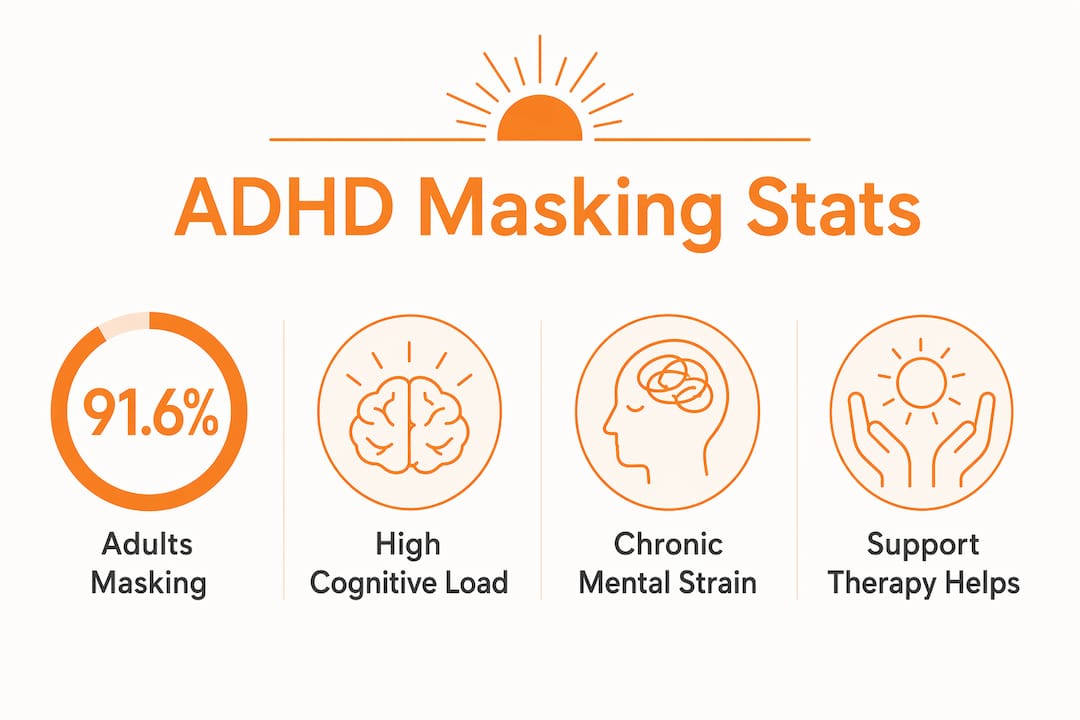
Statistic to know: In a 2026 Simon Fraser University study of 202 adults with ADHD, 91.6% reported masking their ADHD traits in social situations. Masking is not an edge case — it is the norm.
If you recognize yourself in any of this, that recognition is not a reason to feel worse. It is the starting point for something different.
What the research actually says about ADHD masking
The science of ADHD masking is still developing, but the 2026 findings from Simon Fraser University offer the clearest picture yet. In a sample of adults with ADHD, researchers found that hiding, suppressing, or compensating for their ADHD traits in social situations was very prevalent. Participants also reported irritability, anxiety, depression, and needing days to recover after intense camouflaging episodes.
| SFU 2026 Study | Result |
|---|---|
| Sample size | 202 adults with ADHD |
| Reported masking | 91.6% |
| Key outcomes linked to masking | Exhaustion, anxiety, depression, multi-day recovery needs |
The proposed mechanism is cognitive load: masking requires running a continuous background process that competes directly with attention and working memory. For a brain that already struggles with those functions, the additional demand is not trivial.
Much of the broader masking literature draws from autism research, where camouflaging has been studied longer. A PMC-published study on autistic masking found that higher masking was associated with exhaustion, disconnection from identity, and in some cases suicidal ideation — findings that have informed how clinicians think about ADHD masking as well. The mechanistic lessons transfer: masking is driven by stigma, develops across the lifespan, and tends to worsen when coping mechanisms are suppressed alongside the masked traits.
The honest limits of current evidence: most studies are cross-sectional and qualitative, meaning they capture a moment in time rather than tracking people over years. Diverse samples, including adults across racial, cultural, and socioeconomic backgrounds, are underrepresented. Longitudinal research is needed to understand how masking changes with age, treatment, and life circumstances. What is well-established is the prevalence and the direction of harm. What remains open is the precise dose-response relationship and which interventions most effectively reduce harmful masking over time.
How masking affects your ADHD diagnosis and what to do before a clinician visit
Masking is one of the primary reasons ADHD goes undiagnosed or misdiagnosed in adults. When you present as calm, organized, and functional in a clinical setting — because you have spent years learning to do exactly that — the outward appearance of adequate functioning can obscure the real picture. Screening tools like the Adult ADHD Self-Report Scale (ASRS) rely heavily on self-report, and adults who mask tend to underreport symptoms, either because they have normalized them or because they instinctively present their best-managed self.
This is why documentation matters so much. Before a clinical assessment, prepare the following:
- Specific dated examples of functional impairment: a meeting where you lost the thread, a deadline you nearly missed, a conversation you had to script in advance.
- Recovery day records: note how often you need a full day to recover from ordinary social or work demands, and what those days look like.
- A list of compensatory strategies you use automatically (arriving early, over-preparing, scripting) so the clinician understands the effort behind the apparent functioning.
- Input from someone who knows you well at home, not just at work, since masking tends to drop in private settings.
- A description of your internal experience during situations where you appear fine externally — the racing thoughts, the lost thread, the physical effort of sitting still.
Once diagnosed, reducing masking can change what accommodations make sense. Extended time, written instructions, flexible scheduling, and quiet workspaces are all legitimate supports that masking may have previously made you feel you did not deserve. Late or missed diagnosis carries its own emotional weight, and processing that grief is often part of the therapeutic work.
Practical strategies and therapy approaches to reduce harmful masking
Reducing harmful masking is not about stopping all impression management overnight. The goal, as clinicians consistently frame it, is building conscious choice: knowing when you are masking, deciding whether it serves you in that moment, and having real alternatives available when it does not.
A step-by-step starting plan
- Awareness journaling. For one week, write down two or three moments each day when you noticed yourself masking. Note the context, what you suppressed, and how you felt afterward. Patterns will emerge quickly.
- Schedule recovery time deliberately. If you have a demanding social or professional event, block the following morning as protected recovery time. Treat it as non-negotiable, not a luxury.
- Practice selective disclosure. Choose one person in your life — someone you trust — and share one specific ADHD-related challenge with them. Notice what happens. Disclosure does not have to be all-or-nothing.
- Request workplace adjustments. Written agendas before meetings, the option to follow up in writing after verbal discussions, or a quieter workspace are reasonable requests that do not require full disclosure of your diagnosis.
- Build skill, not just awareness. Awareness of masking is the start, not the finish. Therapy, coaching, or structured skill-building gives you tools to replace masking with strategies that actually reduce impairment.
A sample disclosure script
"I want to let you know that I have ADHD, which sometimes means I process information differently in fast-paced conversations. It would really help me if I could get a written summary of key points after our meetings. I'm committed to the work — I just do better with that support in place."
This kind of script works because it names the need, offers context without over-explaining, and proposes a concrete solution. You can adapt it for a manager, a partner, or a close friend.
Therapy and coaching options
- Cognitive Behavioral Therapy (CBT): Targets the thought patterns that drive masking, including perfectionism, fear of judgment, and catastrophizing about how others perceive ADHD traits.
- ADHD coaching: Focuses on practical skill-building, time management, and accountability — useful alongside therapy, not instead of it.
- Acceptance-based approaches (ACT): Help you build a different relationship with ADHD traits rather than fighting them, which reduces the internal pressure that drives masking.
- DBT elements: Particularly useful for emotional regulation, which is often a central masking driver for adults who suppress emotional reactions.
Medication, when appropriate and prescribed by a qualified clinician, can reduce the underlying symptom burden that makes masking feel necessary in the first place. It works best as part of a broader plan that includes behavioral and therapeutic support.
Pro Tip: Start disclosing in the lowest-stakes environment you can find — a trusted friend, a therapist, an online support group. Practicing authenticity in safe spaces builds the confidence to try it in higher-stakes ones.

What to expect when you start unmasking
Unmasking is not a switch you flip. It is a gradual process with real variability depending on how long you have been masking, how much support you have, and what environments you are navigating. Expect it to feel uncomfortable before it feels freeing.
Rough timeline (individual variation is significant):
- First few weeks: You start noticing masking in real time rather than only in retrospect. Small experiments — letting yourself fidget, skipping the scripted opener, saying "I need a minute to think" instead of answering immediately — begin to feel possible in low-stakes settings.
- Months 1–3: Habit patterns start to shift. You test boundaries in relationships and at work. Some disclosures go well; some feel awkward. Both are normal. Recovery time after demanding events may actually increase temporarily as you stop pushing through on adrenaline.
- Months 3–12: Identity shifts become more noticeable. Many adults describe feeling more genuine and less baseline-anxious as they develop the ability to choose when to mask and when to be authentic. This is where the deeper therapeutic gain tends to happen.
Common setbacks include reverting to heavy masking during high-stress periods (performance reviews, family events, new relationships) and feeling like you have "lost" progress. You have not. Stress-triggered masking is predictable, not failure.
Daily and weekly self-care habits that support unmasking:
- Protect at least one low-demand day per week where you do not have to perform for anyone.
- Prioritize sleep — sleep and ADHD have a bidirectional relationship, and poor sleep makes both symptoms and masking worse.
- Plan sensory recovery: quiet time, movement, or whatever your nervous system actually needs after high-demand situations.
- Check in weekly with your journal or a trusted person about where masking felt heaviest that week.
Pro Tip: The goal is not to unmask everywhere at once. Pick one context where the stakes are genuinely low and practice there first. Competence in safe spaces builds the capacity for harder ones.
Red flags and when to seek professional or urgent help
Some signs call for a therapy appointment. Others call for immediate action. Knowing the difference matters.
Seek urgent help now if you are experiencing:
- Suicidal thoughts or thoughts of self-harm (call or text 988, the Suicide and Crisis Lifeline, or go to your nearest emergency room)
- Severe functional decline — unable to work, care for yourself, or maintain basic daily activities
- Substance misuse that has escalated as a way of managing masking-related distress
- A mental health crisis that feels beyond what you can manage alone
Book a therapy or psychiatric appointment soon if you notice:
- Chronic exhaustion that does not improve with rest and is tied to social or professional demands
- Worsening anxiety or depression that has not responded to self-care strategies
- A growing sense of not knowing who you are outside of the roles you perform
- Increasing isolation because social situations cost too much to sustain
- Functional impairment at work or in relationships that you are managing only through extreme compensatory effort
Who to contact depends on what you need:
- A therapist (licensed counselor, psychologist, or clinical social worker) for processing identity, emotional patterns, and building unmasking skills
- A psychiatrist or prescriber if medication evaluation is part of the picture
- An ADHD coach for practical skill-building and accountability, often used alongside therapy
- Your primary care provider as a starting point if you are unsure where to begin
You do not have to be in crisis to deserve support. If masking is limiting your life, that is reason enough to reach out.
Key Takeaways
ADHD masking is nearly universal among adults with ADHD, and the cognitive and emotional costs of long-term masking are well-documented — but conscious, paced unmasking with professional support can meaningfully improve both functioning and identity.
| Point | Details |
|---|---|
| Masking is extremely common | A 2026 SFU study found 91.6% of adults with ADHD reported masking their traits in social situations. |
| Cognitive cost is real | Suppressing ADHD traits impairs attention and memory, worsening the symptoms masking is meant to hide. |
| Masking delays diagnosis | Appearing functional in clinical settings leads to underreporting and missed or late ADHD diagnoses. |
| Unmasking takes time and safety | Effective unmasking is gradual — start in low-stakes settings and build from there over months, not days. |
| Professional support accelerates recovery | Sunshinecitycounseling offers individual therapy for ADHD, anxiety, and identity work in St. Petersburg, FL and via telehealth across Florida. |
What unmasking really asks of you
There is a version of the unmasking conversation that makes it sound like a relief — like you just stop pretending and everything gets easier. That is not quite right, and I think it is worth saying plainly.
For most adults who have masked for years, the first experience of unmasking is disorienting rather than freeing. You have organized your entire social identity around a performance, and when you start stepping back from it, you often do not immediately know what is underneath. That uncertainty is not a sign that something is wrong with you. It is what happens when you have been running on a survival strategy for so long that it started to feel like your actual self.
What the research and clinical experience both point to is that the deepest gain is not symptom reduction — it is identity reclamation. Adults who do this work, at a pace that feels safe, in environments that support them, often describe feeling genuinely less anxious at baseline. Not because their ADHD disappeared, but because they stopped spending half their cognitive energy managing how it looks to everyone else.
The safety-first approach matters here. Trying to unmask in a high-stakes environment before you have practiced in safer ones is likely to backfire and reinforce the belief that authenticity is dangerous. Therapy is not the only path, but for many adults it is the most reliable one — because it gives you a space where the performance is explicitly not required.
Sunshinecitycounseling can help you stop performing and start recovering
If you have read this far and recognized yourself in more than a few of these patterns, you are not alone — and you do not have to figure out the next step by yourself.
Sunshinecitycounseling offers individual therapy in St. Petersburg, FL, and telehealth sessions for adults across Florida, with a specific focus on ADHD, anxiety, depression, and the identity work that comes with late diagnosis and long-term masking. The therapists here work from a trauma-informed, client-centered approach — which means the goal is never to tell you to stop masking cold turkey, but to help you build the awareness, skills, and safety to choose when and how you show up authentically.
Whether you are newly diagnosed, still questioning, or years into managing ADHD on your own, a first therapy session is a low-pressure way to talk through what masking has cost you and what recovery could look like for your specific life. Reach out to Sunshinecitycounseling to schedule a consult or a 15-minute intake call — and start building a version of support that actually fits how your brain works.
Useful sources and further reading
These resources are vetted for accuracy and clinical relevance. Use them to go deeper on any section of this article.
- Adults with ADHD may pay high price to mask traits and fit in — SFU News: The primary source for the 2026 study data cited throughout this article, including the 91.6% masking prevalence figure and cognitive-load findings.
- ADHD masking: Pretending to be neurotypical is unhealthy — ADDitude: Clinically reviewed explainer covering signs, consequences, and therapy recommendations; useful for readers who want a practitioner-oriented overview.
- ADHD masking: Examples, impact, and coping — Verywell Mind: Accessible, example-rich breakdown of masking behaviors and their impact; good starting point for readers new to the concept.
- ADHD masking — Attention Deficit Disorder Association (ADDA): Advocacy-informed resource that frames masking as a survival strategy and offers practical guidance on reducing it; useful for adults and their support networks.
- Masking — National Autistic Society (UK): Covers the autistic camouflaging literature that informs much of the ADHD masking research; particularly relevant for readers who are both autistic and ADHD.
- Autism masking: Signs, effects, and support strategies — Medical News Today: Clear summary of masking mechanisms and safety-first unmasking strategies drawn from clinical guidance.
- What You Are Hiding Could Be Hurting You — PMC/NCBI: Peer-reviewed study linking autistic masking to interpersonal trauma, anxiety, depression, and lower self-esteem; the statistical findings are directly relevant to ADHD masking research.
- Midlife ADHD? Coping strategies that can help — Harvard Health: Practical adult ADHD coping strategies from Harvard Medical School; useful companion reading for the coping and treatment section.
- Adult ADHD Self-Report Scale (ASRS): A validated screening tool commonly used in clinical settings; ask your clinician about it if you are preparing for a diagnostic assessment.
- 988 Suicide and Crisis Lifeline: Call or text 988 from anywhere in the United States for immediate mental health crisis support. If you are in immediate danger, call 911 or go to your nearest emergency room.
This article is for general informational purposes only and is not a substitute for professional mental health advice, diagnosis, or treatment. Please consult a qualified clinician for guidance specific to your situation.